
How much effort is enough? How much attention? How much “success”?
Leading up to the publication of my recent novel, Kohelette, I couldn’t help but be aware of all the publishing professionals said a successful author should do to launch a book. The pitches, the marketing, and the business of it all stayed in my mind well after I left my desk each day. The sense of intense pressure caught my attention, as did a deepening desire to step away from it.
I know the pressure to do-do-do isn’t unique to writing or publishing. I remember one morning early in my days as a pastor when I crawled under a desk because it was the one place in the pastor’s office not visible from a window in my closed office door. So many people had found me that morning already, so many details and issues had agitated for my attention, that I needed a moment to not be findable. My stress-ragged mind couldn’t come up with anything better than to hide under a desk.
The pressure to be productive feels relentless across many fields and communities.
In recent years, one way I’ve coped with these cultural expectations around work is by building in regular time for creativity. Getting lost in painting or writing stories often helps me downshift and relax. I think that’s why the frenzy of the writing and publishing worlds so caught me off guard. I hadn’t prepared for my creative writing hobby to lead me into a booming capitalist landscape targeting writers’ anxieties around gaining attention from literary agents, publishers, and/or readers. The pressure to do more and achieve more is intense. I’m still adjusting to this new-to-me facet of grind culture.
On the one hand, the ball is in my court to manage my engagement with this culture. On the other hand, that ball doesn’t exactly fall into any one person’s court. This frenzy is the tone of society. It’s a culture-wide grind mentality that equates success, professional gravitas, and even faithfulness with a frenetic pace, achievement-orientated goals, metrics-conscious lenses, and constant striving. The issue has to do with so much more than any one individual’s efforts.
In my Substack newsletter this month, I brainstorm around some of my own responses. Here, I offer brief reviews of two books I’ve kept close recently. Both push back against fast-paced contemporary life with social analyses and spiritual perspectives. Both let me try on different lenses for thinking through my experience and how much bigger the dynamics are than my one experience alone. Read on for a bit about Tricia Hersey’s Rest is Resistance: A Manifesto and Wayne Muller’s A Life of Being, Having, and Doing Enough. See what you think.
Reviews
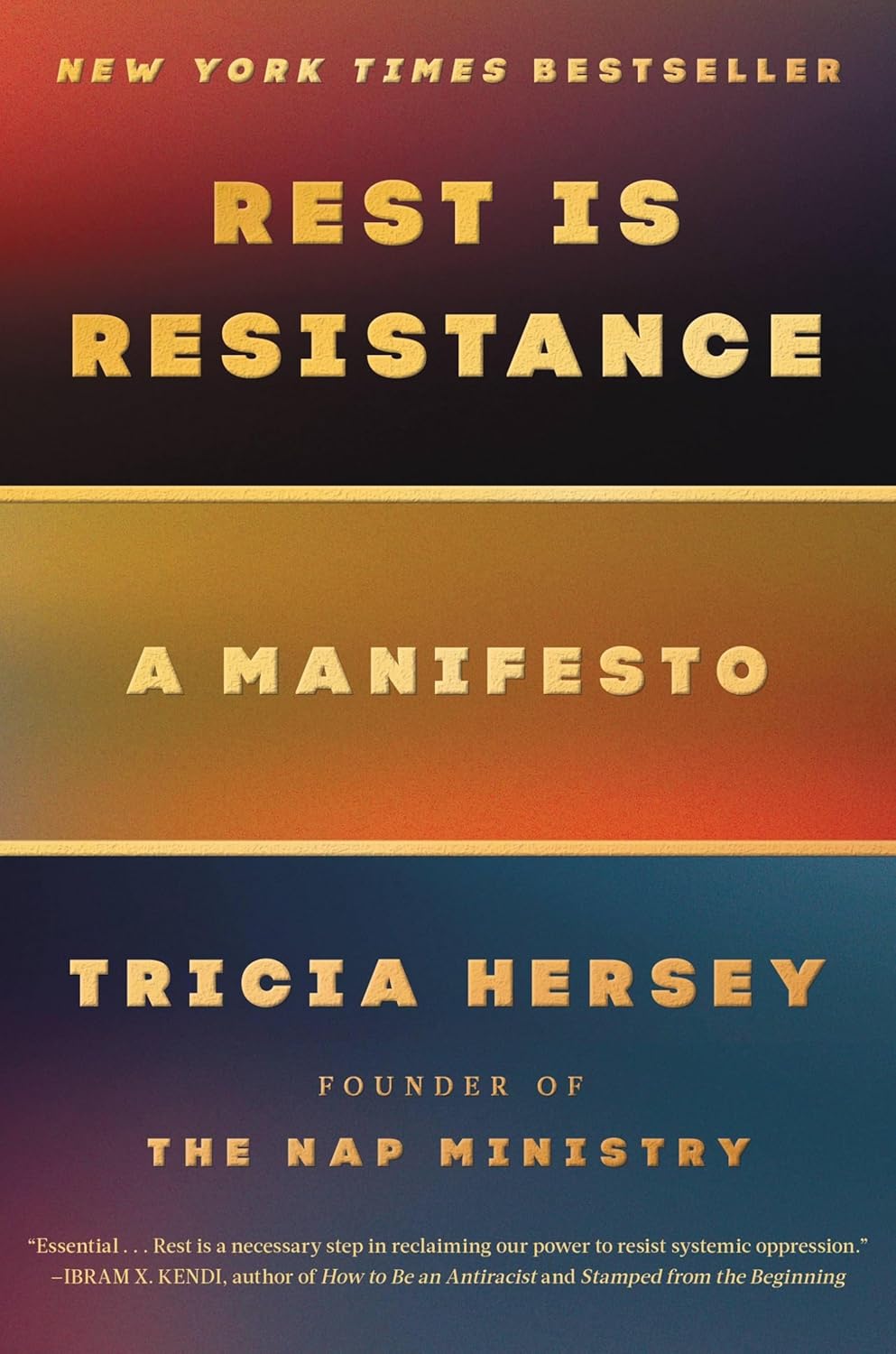
Rest is Resistance: A Manifesto
By Tricia Hersey
Little, Brown Spark (2022)
ISBN-13: 978-0316365536
“To rest,” writes Tricia Hersey in her New York Times bestselling Rest Is Resistance: A Manifesto, “is to creatively respond to grind culture’s call to do more.” Tricia Hersey, who refers to herself as The Nap Bishop, is an artist, writer, theologian, community organizer, and founder of The Nap Ministry. She draws attention to the racial and social justice issues involved in rest. Rest is Resistance, specifically, calls for a season of experimentation that trusts in human worth more than capitalism’s model of scarcity.
Part pep talk, part sermon, part social analysis and manifesto, Rest is Resistance divides its discussion into four sections: rest, dream, resist, and imagine. “My commitment to rest as a form of resistance,” Hersey says, “came from my everyday experiences of being a part of the machine-level pace of our culture and surviving the trauma of the terror of poverty, exhaustion, white supremacy, and capitalism.” She devotes space throughout the book to describing these historical and current challenges in our society and draws extensively from her own experience.
Hersey acknowledges that we, as a society and as individuals shaped by grind culture, may not even know what rest feels like. She notes that visualizing “what a world without capitalism and oppression looks like” is based on something she hasn’t experienced before, calling such visualization a form of “dreamwork and alchemy.” While evoking the massive scope of such a project, Hersey also proposes efforts for dismantling “the cult of busyness one person at a time” on the way to that larger, “global mind shift.” She offers glimpses from her experience and suggestions for experimentation while acknowledging the context-dependent character of rest.
Rest is Resistance does not lay out a detailed plan for liberation from grind culture. I kept wishing it would! But I realize that may be an overly simplistic desire. It also isn’t the project of this particular book. Rather, Hersey’s grounding in Black liberation theology and womanism gives important voice to justice issues in our society’s relationship with rest. She also provides vocabulary and encouraging refrains for nurturing ourselves and our communities in the ongoing struggle. I recommend Hersey’s book.
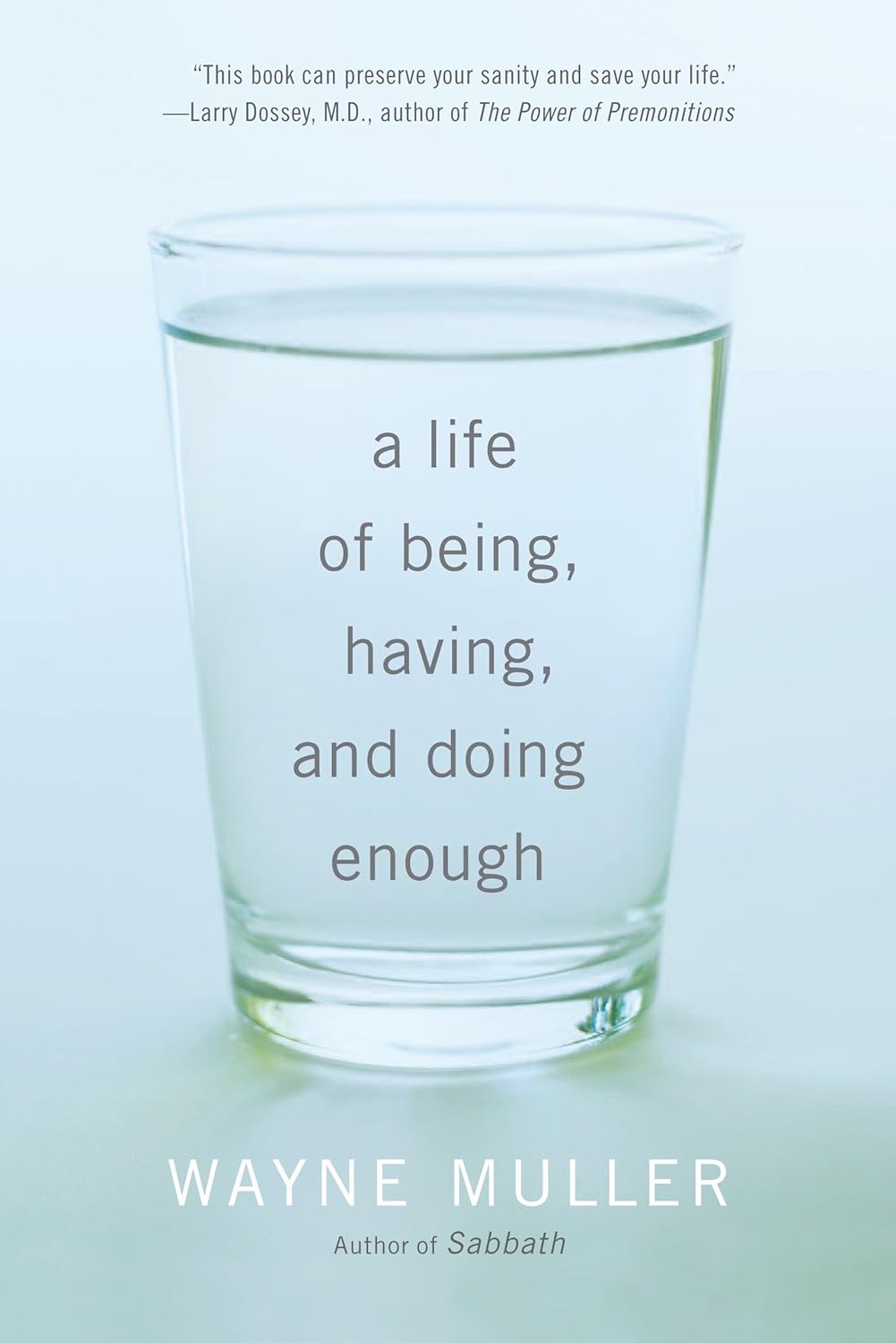
A Life of Being, Having, and Doing Enough
By Wayne Muller
Three Rivers Press (2011)
ISBN-13: 978-0307591395
“We live in a world seduced by its own unlimited potential,” writes Wayne Muller at the outset of A Life of Being, Having, and Doing Enough. A therapist, minister, community advocate, bestselling author, and founder of the grassroots philanthropy organization Bread for the Journey, Muller describes an exhaustion across the spectrum of people and organizations he encounters. His book issues a call to rest and experience “enough” in the midst of a world unlikely to support such well-being.
A Life of Being, Having, and Doing Enough unfolds in short chapters alternating between story and reflection. Muller’s own experience of a heart attack, with recovery time enforcing a slower pace and narrowed focus, still shapes his thinking. While he does diagnose the unfortunate state of western society with its difficulties slowing down, Muller gives much of his energy to constructive efforts, lifting up the small “choice points” in life as moments deserving of even more attention.
Muller offers multiple lenses for exploring a life of “enough.” For example, he describes a practice of choosing “the next right thing,” seeking the guidance of what we love rather than how much we can handle. He also draws on multiple faith traditions, from the Ten Commandments and the Buddha’s Eightfold Path to the Five Pillars of Islam, to evoke an “intrinsic wisdom” that guides us in navigating an often-disordered world. Muller lifts up values like the worth of small things, the practice of bearing witness, and the richness of present moments.
I first encountered this book a dozen or so years ago. Its questions and practices around “enough” have stayed with me. I do still struggle with the same things I struggled with all those years ago: what to pursue and what to leave alone, and how to draw boundaries around my time and energy. In some ways, though, I suspect I’m integrating Muller’s insights, appreciating more and more over time his claim that “enough is born in every moment … every single choice, every single moment, every change of course [that] can bring us closer to a life of peace, contentment, authenticity.” This book’s a keeper.
###
What about you? Any good books or helpful voices you’ve found as you manage the pace of your own environments? Please leave comments below!
Kohelette: A Novel
is now available
She wants to do something new with her life,
but she may need the dead to help her do it.
Domestic fiction meets magical realism in Kohelette,
a story of piecing together life after loss.
Kohelette came out of my opportunity to participate in the Religion, Spirituality, and the Arts Seminar (RSA), which gathered a cohort of twelve artists for seven months in shared study of a sacred text. We studied the book of Ecclesiastes, with each artist creating a project in response. Click here to read my blog series on this project.


Leave a Reply