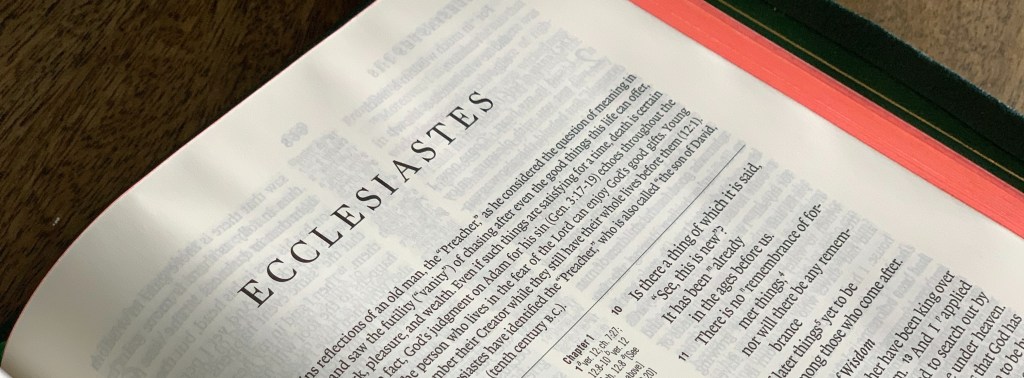
What if I told you that all your efforts amounted to no more than a mere breath? And not even to a deep and life-giving breath, but only the weak vapor of an exhale?
Hevel – breath. It’s the Hebrew word the King James Bible translates as “vanity.” More recently, Robert Alter has translated it as “mere breath,” like the flimsy vapor of an exhale. The author of Ecclesiastes (who in Alter’s translation identifies himself as Qohelet) declares that all things are hevel. It’s a rather stark commentary on the value of human effort.
In her essay “Ecclesiastes as Witness: A Personal Essay,” poet Alicia Ostriker remarks on how, even though Qohelet uses the word hevel, which is different than the Hebrew word ruach, or the breath of life that God breathes into humanity at creation, the breath metaphor no less offers “a suggestion simultaneously of that which is essential to life and that which is utterly ephemeral” (p. 8). The ambiguity resonates, doesn’t it? So many things we give so much effort to last such brief snatches of time in the scheme of things.
And yet I chafe at the implications of declaring “all things” to be ephemeral. I’m deciding what to do with that.
I’m in the middle of a wonderful opportunity called the Religion, Spirituality, and the Arts Seminar (RSA), a program of the Herron School of Art + Design at IUPUI in Indianapolis. The RSA gathers a cohort of artists (e.g., poets and other writers, musicians, visual artists, fiber artists, photographers, sculptors, etc.) for shared study of a sacred text with the guidance of a multidisciplinary faculty. My cohort is focusing on the book of Ecclesiastes.
So far, we’ve been meeting for RSA sessions at the Indianapolis Museum of Art. On break during our first session, I remember children there for the museum’s Harvest Nights festival doing exuberant cartwheels down the hall. It made me appreciate the venue all the more that it included cartwheels. Granted, my colleagues and I haven’t exactly been doing cartwheels, but we are an interestingly diverse group with a lot of energy and a lot to say. I’m sorting through perspectives right now, wondering which ones to inhabit as I live with Ecclesiastes’ rather striking statements about human existence.
As I alluded to earlier, Qohelet declares that “all is mere breath, and herding the wind” (1:14, Robert Alter translation). What do I make of that? What do you make of that?
I do appreciate the candid acknowledgement of how ephemeral so many of our efforts, value systems, relationships, accomplishments, and possessions can be. Those who are grieving may very well resonate with Qohelet on how vulnerable our lives are to death, losses and endings, the passing of realities that have been, and the frustration of dreams that never were.
In fact, given the way Qohelet goes on and on about things that don’t last and don’t make any difference (e.g., justice, wisdom, and human memory), I’ve started to see in his extensive lament a form of remembering (even though he says memory doesn’t last) that keeps the ideas of these things alive. In other words, his refusal to move on from what he’s lost keeps those lost things front and center. Absence evokes presence. Arguably, the lost things haven’t entirely gone away. Not really.
Perhaps because of this way Qohelet uses absence to evoke presence, I find myself wanting – in that same spirit – to push back against Ecclesiastes in its everything-is-hevel conclusions. I want to hope that our efforts, relationships, and dreams – though they may be mere breath – can amount to more than mere breath, as well. I want to believe that the lastingness of a thing is not the only mark of its value. I want to imagine that children’s cartwheels down art museum halls, and artists creating together, and the work of people who don’t even give a flying fig about art, could all add up to a world that we leave a little better for our having been here. I want to say more than Qohelet does about what is lasting in and possible for human life.
And so, I’m considering. I’m reading and reflecting. I’m listening to many perspectives on the text over the years and across communities. I’m discussing all of this with colleagues. I’m trying to remain open to a better understanding of what Ecclesiastes may be saying and what kinds of truths it carries.
I’m also writing. The culmination of our seminar involves projects that respond, in our own artistic disciplines, to Ecclesiastes. Our creative task could be compared to the tradition of “Midrash,” which is telling stories about Bible stories, exploring angles on which the stories are silent (e.g., what Qohelet was like as a child) or listening to voices the stories did not allow to speak (e.g., what the spouse of Qohelet had to say). The founder of the RSA, Rabbi Sandy Eisenberg Sasso, wrote a wonderful book on Midrash, Midrash: Reading the Bible with Question Marks, exploring this creative way of entering into conversation with the Bible. I’ve found it a life-giving invitation.
In that same spirit, this blog piece will begin a series of reflections on my experience engaging Ecclesiastes as well as on what’s emerging for me as I work on my final project for the seminar: a new piece of fiction. I’m eager to see what Qohelet and I end up saying to one another.
Would you be interested in having a say, too?
For the next few months, my second (and maybe even a third?) blog post each month will be available to my blog subscribers only, and it will hold an excerpt from the draft of the novella I’m writing in response to our study of Ecclesiastes.* If you’re a subscriber (and if you’re not, I warmly invite you to sign up in the sidebar of this site), I’ll be eager to see any reflections you may want to share in response to these excerpts. I’ll value your feedback as I continue to write and revise. As I’m learning with the RSA, I enjoy creating, but I enjoy it even more when I do it with other people involved and with heavy doses of conversation.
If you’re game for that, then I’ll look forward to hearing from you! For now, stay tuned …
2025 Update: An expanded version of the novella To Tend the Wind, retitled Kohelette: A Novel, will be available from Clay Patin Press in 2026.


 Callie J. Smith
Leave a comment