I don’t believe creative block is limited to artistic work. Simply managing to live our lives can require all kinds of creativity and leave us facing many versions of feeling stuck. I’ve felt it when facing organizational projects, gatherings of people (have I mentioned I’m an introvert?), house cleaning, degreasing my bike chain, and visiting certain relatives. I’ve lacked the energy, inspiration, and whatever-it-takes to deal with all sorts of things. Sometimes I get stuck.
Ever been there?
I think the writer of Ecclesiastes ended up there. I’ve been thinking a lot about him and his version of creative block, and I find myself responding to his disillusionment.
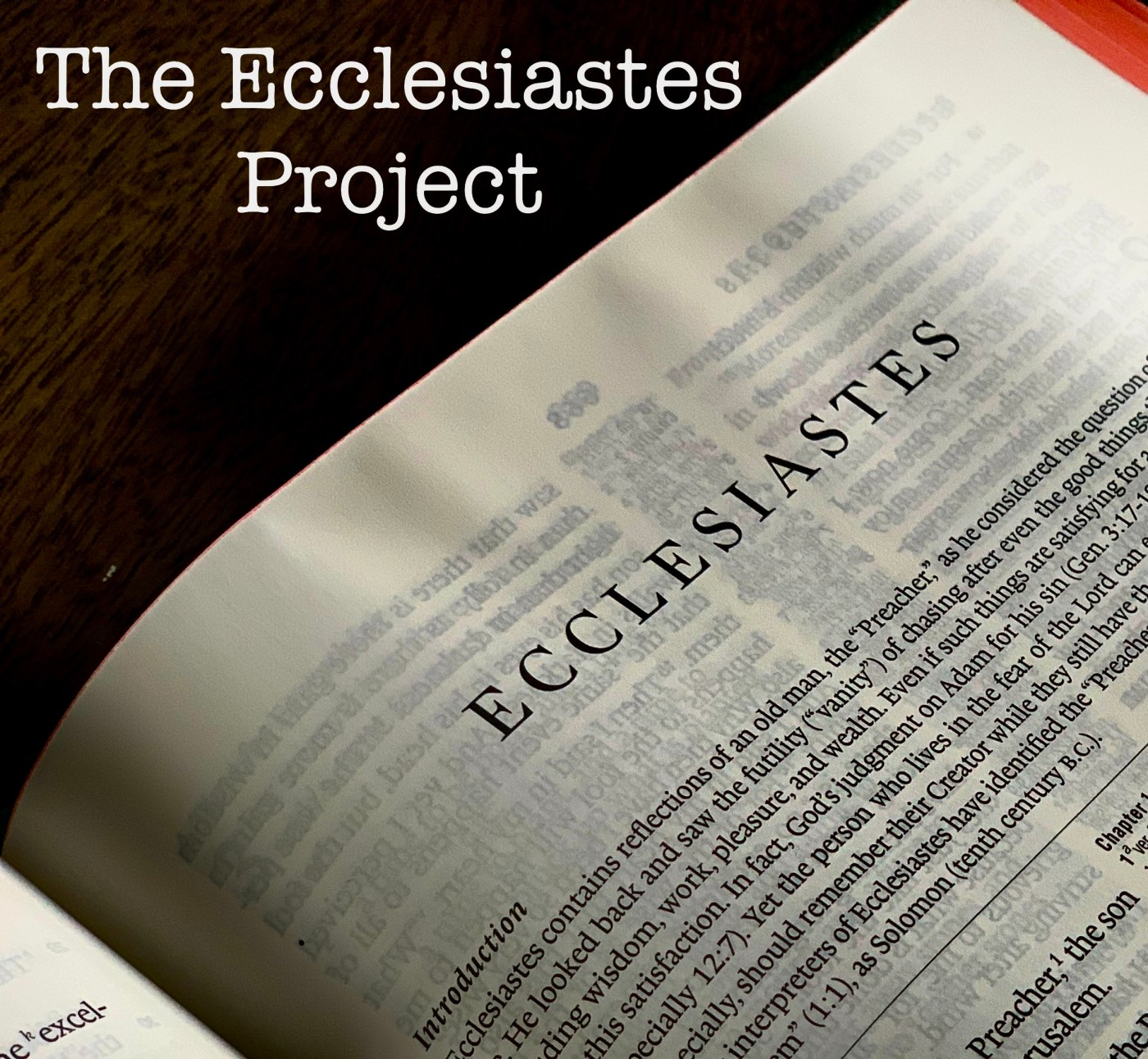
I’m working on a project for the May 2024 exhibit at the Harrison Center in Indianapolis titled “Is There Nothing New Under the Sun? A Conversation with Ecclesiastes, Religion Spirituality and the Arts 2024.” In conjunction with the Religion, Spirituality and the Arts seminar (which is putting on this exhibit), I’ve been writing a novella titled To Tend the Wind as a response to my reading of Ecclesiastes. I sense that the writer of Ecclesiastes has become disoriented in his value system and come to a sort of standstill in his life. My novella is, in some ways, me imagining this man digging himself out of the stuck place he was in and finding a way to live beyond it.
Perhaps it’s no surprise that this project has leant itself to my own creative block in writing. I’ve found myself staring at a computer screen with my manuscript ready and waiting for me to continue with it, and … I don’t want to do it. I just want to walk away. I don’t know why this happens with something I enjoy as much as writing, but it does.
And because it does, I’ve started observing myself at those times. The thing that has struck me most recently is this: my mood state during those blocks does not fully reflect my capacity for pursuing the task before me.
This has felt like an especially important observation given the amount of time I’ve been spending with Ecclesiastes. The author of Ecclesiastes is deeply discouraged and rather stuck there. Such experiences are part of life at one time or another for many of us, which may have been part of the speaking power of Ecclesiastes over the years. What do we do with that discouragement if we’re going to make our way through the day in front of us? And then the next day? And the next?
I have no grand answers. Lately, though, I’ve been trying to pause. I’ve been trying to let my feelings be what they are for even just a little while and then turn my attention back to the computer screen. And even when I still haven’t felt like writing, I’ve been writing anyway.
Sometimes, I’ve been pleasantly surprised by the results. Sometimes, I’ve gotten enjoyably lost in the project. Not always, though.
Sometimes I’ve only taken miniscule next steps by making myself stay at my desk for half an hour. Maybe it’s only resulted in writing a quarter of a page. Perhaps I’ve only reviewed some problematic part of the story. These are small steps, but they’ve at least opened the door for next steps. And I’ve been realizing how important next steps are.
In fact, part of my dissatisfaction with Ecclesiastes is that the writer didn’t seem to take much of a next step with his insights about living. “Let oil on your head not be lacking,” he says in one of his most well-developed statements as to what humans can, at best, do with their lives. “Enjoy life with the wife whom you love all the days of your vain life that are given you under the sun, because that is your portion in life and in your toil at which you toil under the sun.” (Ecclesiastes 9:9). As with this passage, Ecclesiastes does envision moving forward with life, but it doesn’t go very far in drawing that picture, and it certainly doesn’t get into many specifics.
I’ve wanted to hear more about when the writer had to remind himself to put oil on his head. I’ve wanted to hear about the women in his life. I’ve wanted glimpses into how his story unfolded beyond his disembodied philosophical reflections.
So, I’ve written my own protagonist who carries some of that same disillusionment and discouragement even as she also tries to raise a 12-year-old daughter as a single parent, find a way to keep her family’s home, and maybe even resurrect an old dream or two. In my story, this protagonist has an everyday, embodied human existence that she has to figure out how to handle, and she’s stumbling through her next steps. It’s felt satisfying to take my dissatisfaction with Ecclesiastes and make this next step with it.
As I’ve mentioned in this blog series on Ecclesiastes, I’m offering excerpts of my novella to my blog subscribers. (It’s not too late to subscribe – it’s free!) Some of these excerpts will also be part of the May 2024 “Is There Nothing New Under the Sun?” exhibit in the Underground Gallery of the Harrison Center. I’ll be giving a reading from the To Tend the Wind novella at the exhibit opening event on Friday, May 3, 2024, from 6-9 pm. If you’re in the Indianapolis area, please mark your calendar! But even if you can’t make it, there will be a virtual exhibit, and the full To Tend the Wind novella will be available later this month on my website through August 1, 2024 (after which time the story will come down for revisions). So, stay tuned. And in the meantime, I’m wishing you opportunities to stumble upon some of your own next steps.
2025 Update: An expanded version of the novella To Tend the Wind, retitled Kohelette: A Novel, will be available from Clay Patin Press in 2026.

 Callie J. Smith
Leave a comment