I’m trying to imagine myself among those gathered to hear Qohelet speak. (Qohelet, Koheleth, the Preacher, the Teacher – different translations of the Bible refer to the author of Ecclesiastes in different ways.) Would there be any other women there, and would we even have opportunity to experiment in the ways Qohelet says he experimented, with revelry and folly? How would I react? Would I be attentive or annoyed?
Better yet, forget about me. Imagine Qohelet’s spouse overhearing him earlier in the day as he prepares his remarks for the crowd. (Qohelet doesn’t reference having a spouse, but let’s assume he had one at some point.) How would she react? Would she admire his learnedness? Would she roll her eyes at his declarations that “all is mere breath” (1:14, Robert Alter translation), knowing he wouldn’t accept that explanation if he arrived home for dinner and found she hadn’t bothered with something as ephemeral as cooking?
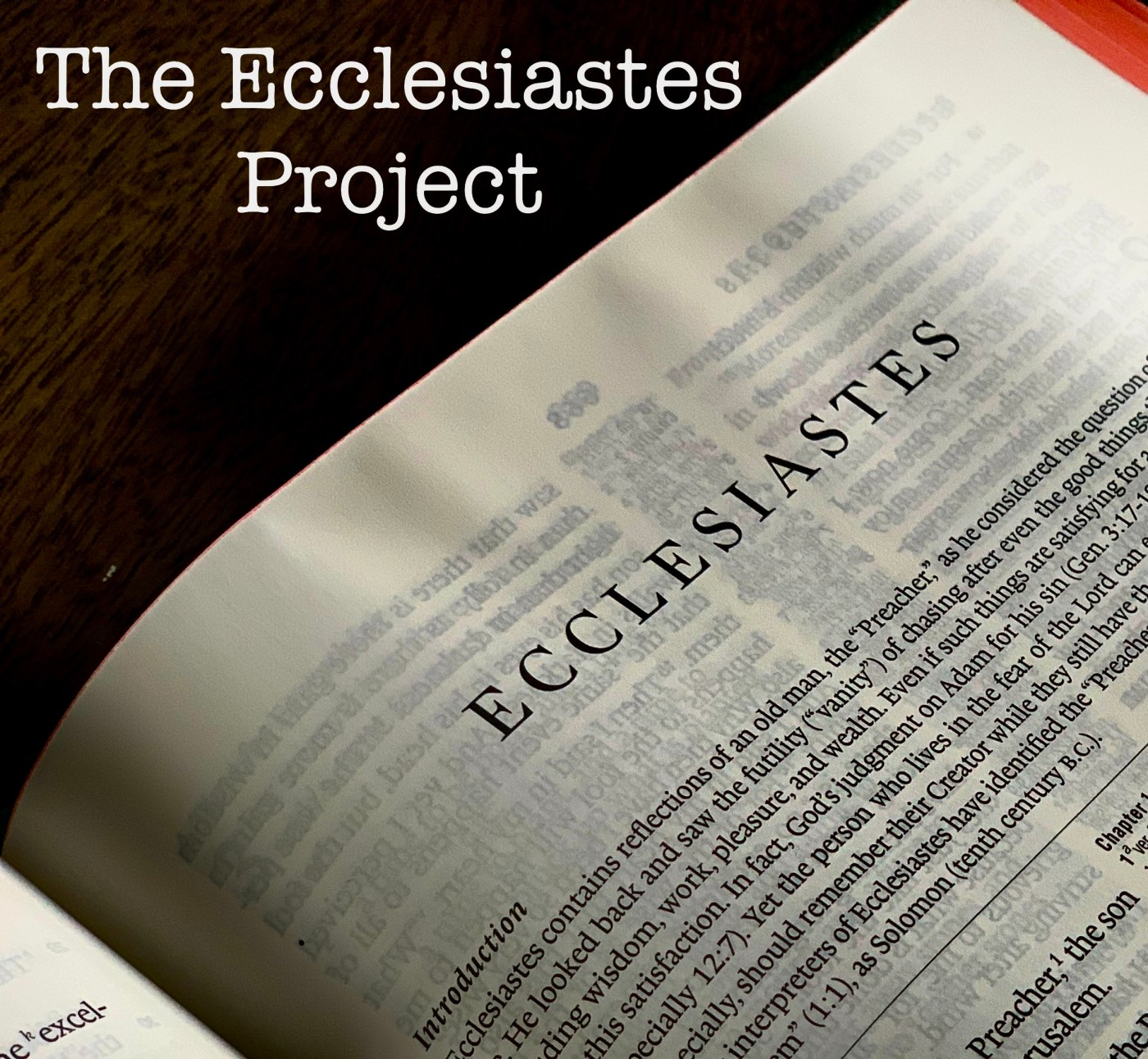
As I’ve explained elsewhere, such questions draw on a tradition called “Midrash” of telling stories about Bible stories, creatively engaging the book by raising questions about its white space (a.k.a. the white of a page around its black printed letters). I’ve been getting a lot of practice with this as I participate in the Religion, Spirituality, and the Arts Seminar (RSA), a cohort of artists sharing in the study of Ecclesiastes with guidance from a multidisciplinary faculty. Our study culminates in creative projects that respond to the text, and I’ve been working feverishly on a novella with … drum roll … a female narrator.
I’ve relished this project for the chance to tackle topics in Ecclesiastes from a woman’s perspective. My hunch is that Qohelet needs a woman’s perspective. It’s Qohelet, after all, who remarks, “I find woman more bitter than death. For she is all snares, and nets her heart, and fetters her arms” (7:26, Robert Alter translation). The NRSVue translation does moderate the accusation a bit, stopping short of belittling all women by saying, “I found more bitter than death the woman who is a trap, whose heart is nets, whose hands are fetters; one who pleases God escapes her, but the sinner is taken by her” (7:26). Regardless, these passages suggest a man with some issues around women. In many ways, women and the things traditionally associated with us (e.g., interpersonal relationships and mundane daily life) remain white space in Ecclesiastes. I mean to explore that space in my writing.
In my novella writing project,* I’m writing of a contemporary woman who’s disillusioned and grieving, who’s lost her job and is facing the possibility of losing her family’s home. She’s wondering how to raise a rebellious pre-teen. She’s dealing with things that Qohelet doesn’t by and large represent, and yet she begins to resonate with him as she grieves relationships that have changed or ended and wonders what to do with the transience of so much in her life.
Ever been there?
I suspect more of us have been there than we let on. Perhaps that’s why Ecclesiastes’ stark commentary has stayed in our cultural imagination for so long. On some level, we recognize the weariness that comes with experience.
At the same time, I’ve found many parts of Ecclesiastes that do not resonate for me. Take, for example, one of Qohelet’s most well-developed statements of what we as humans should be about. “At every season let your garments be white and let oil on your head not be lacking,” Qohelet says. “Enjoy life with a woman whom you love all your days of mere breath that have been given to you under the sun, all your days of mere breath, for that is your share in life and in your toil” (Ecclesiastes 9:9-10, Robert Alter translation). Even I, so critical of how Qohelet speaks about women in other passages, can acknowledge that a woman has made it onto Qohelet’s list of good things in life.
And yet, as insight into how it is good for humans to live, I keep wanting more from Ecclesiastes. How does a person live with this insight and build a life on it? What did it look like when Qohelet got to the point of taking his own advice? Perhaps such questions fall outside the scope of Ecclesiastes. In which case, I find myself grateful yet again for the tradition of Midrash.
This blog post is part of a series reflecting on my experiences with the RSA seminar and sharing the novella that’s emerging as a response to Ecclesiastes. I’m incredibly grateful for this seminar and for the artists I’ve gotten to know through it. I’m looking forward to encountering my colleagues’ finished projects at the May 3rd opening of our exhibit at the Harrison Center in Indianapolis.
What about you? If you were to create something in response to Ecclesiastes, what would you write, design, paint, record, build, or otherwise make? What story would you tell?
* 2025 Update: An expanded version of the novella To Tend the Wind, retitled Kohelette: A Novel, will be available from Clay Patin Press in 2026.

 Callie J. Smith
Leave a comment